The Science of Habits and Accountability: What Research Actually Says
The Science of Habits and Accountability: What Research Actually Says
Every January, millions of people write resolutions they do not keep. By the second week of February, most gyms have gone quiet again. The treadmill that was new in January is a coat rack by March.
We have all been there. And for decades, the standard explanation has been the same: I just did not have enough willpower.
The research tells a very different story. The problem is rarely a shortage of willpower. It is a poorly designed system. When you understand how habits actually form, and what accountability actually does to your brain and your behavior, the whole picture changes. This is a long, evidence-first dive into that science, built for people who want to understand why habits fail and what actually works when it comes to following through with an accountability partner, a group, or a tool.
The Gap Between What We Intend and What We Do
Let us start with a number that should reframe everything: intentions explain only about 28% of the variance in behavior.
This is the finding of a landmark meta-analysis by Peter Gollwitzer and Paschal Sheeran, who aggregated 422 studies and 82,107 participants across ten separate meta-analyses of the intention-behavior relationship. Their conclusion, published in Advances in Experimental Social Psychology (2006), was that a strong intention ["I intend to exercise daily"] predicts actual follow-through poorly. In a companion meta-analysis of 47 experimental studies, they found that even when an intervention successfully strengthened people's intentions a large amount, the resulting change in behavior was small. There is a wide, well-documented chasm between wanting to do something and doing it.
Why is this gap so stubborn? The dominant explanation has been ego depletion. In a long series of experiments associated with Roy Baumeister and colleagues, researchers showed that self-control appeared to be a depletable resource: resist cookies once, and you are measurably worse at resisting the next temptation. Every decision, what to eat, what to wear, whether to reply to that email, appeared to draw from the same limited pool.
The precise mechanism of ego depletion is contested and has been difficult to replicate in large pre-registered trials, but the practical takeaway has not been overturned: relying on moment-to-moment willpower is a fragile strategy. By the end of a long day, your reserves are low, and your intentions quietly lose. The person who reads at 7am and the person who tries to read at 10pm are not the same person. One is sharp and motivated; the other has spent the whole day deciding things and is out of gas.
So if willpower is not the answer, what is? The short answer: automaticity and accountability. One makes the behavior effortless; the other makes it nearly impossible to skip.
How Habits Actually Form: The Automaticity Curve
For decades, pop culture has repeated the idea that it takes 21 days to form a habit. It is one of the most durable myths in self-improvement, and the research does not support it.
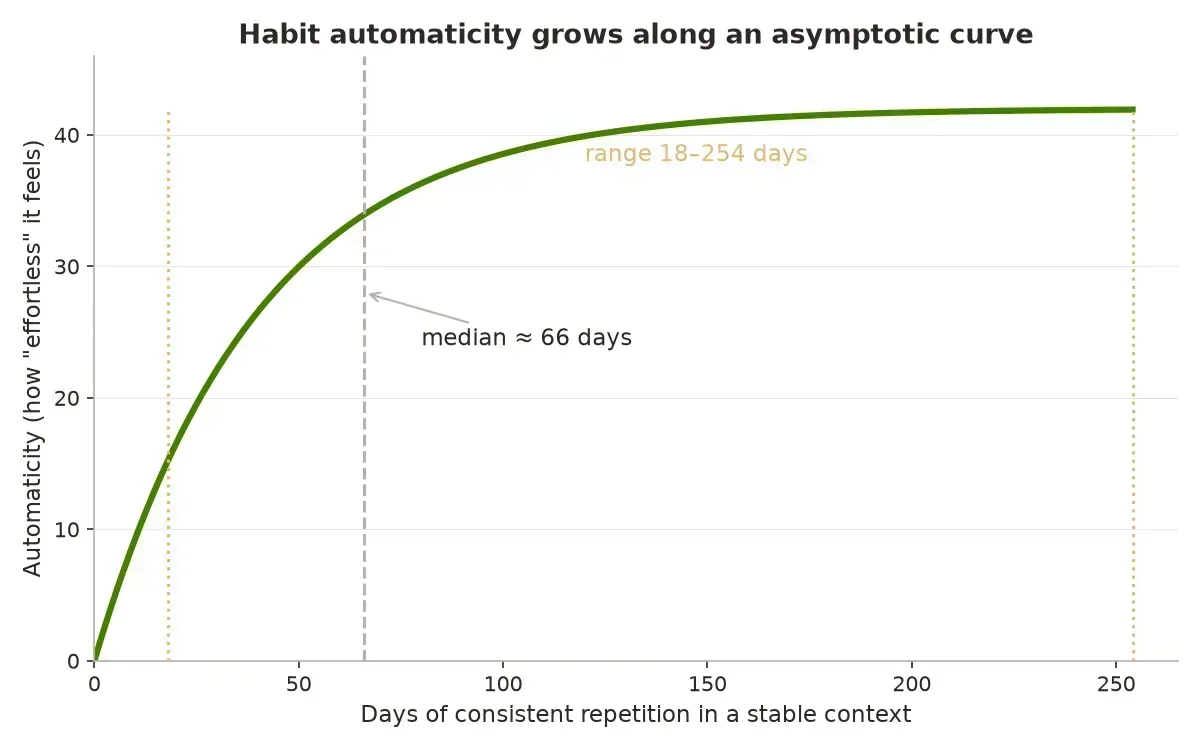
The best-known study on this comes from Phillippa Lally and colleagues at University College London, published in the European Journal of Social Psychology (2010). They tracked 96 volunteers who chose a small daily behavior to adopt, such as eating a piece of fruit with lunch, drinking a bottle of water, or running for 15 minutes before dinner, and asked them to repeat it in the same context every day for 12 weeks. Participants completed a daily self-report measure of automaticity: how much the behavior felt automatic, something they did without thinking.
The results reshaped how we think about habits:
- Automaticity increased along an asymptotic curve that leveled off over time, not on a strict day-count schedule.
- The median time to reach 95% of full automaticity was 66 days. But the range was enormous: from 18 to 254 days. One size does not fit all.
- Missing a single day did not materially harm the habit formation process. This is a crucial, counterintuitive finding. The people who failed were not the ones who slipped up once; they were the ones who were chronically inconsistent.
- Contextual consistency mattered. Repeating the behavior in the same setting (e.g., "after breakfast") made automaticity grow faster than repeating it randomly.
A 2024 systematic review and meta-analysis in Healthcare (Singh, Murphy, Maher & Smith) consolidated 20 studies and 2,601 participants and reached a similar conclusion: median habit-formation times clustered around 59 to 66 days, with mean times ranging from 106 to 154 days depending on the behavior and person. The variation between individuals is massive, and it is the rule, not the exception.
What this means for you is freeing: a missed day is not a failure, but inconsistency is. You are not restarting the countdown to zero because you stumbled once. The goal is a stable context and repeated execution, not a perfect streak. When a behavior becomes automatic, the decision is largely made before you even think about it. The cue appears, and the action follows.
The Three Ingredients of Automaticity
Modern habit science distills the machinery of automaticity into a loop of cue, routine, reward, sometimes written as cue → craving → response → reward. The neuroscientist Ann Graybiel and others have shown that habits live in the basal ganglia, the older, more primitive parts of the brain that run learned sequences without needing the conscious, energy-hungry prefrontal cortex. That is why habits are efficient: they move behavior from the conscious "expensive" part of the brain to the automatic "cheap" part.
Neuroscientists describe this as a shift from goal-directed control to habitual control. Early in a behavior's life, you are deliberately deciding, effortfully choosing, and paying close attention to the outcome. This is goal-directed control: your prefrontal cortex is running the show. With repetition, control shifts to the habit system. The decision, the effort, and the attention are handed off to circuits that run the sequence quickly and cheaply. This is also why reward timing matters so much: dopamine, the learning signal the brain uses to tag behaviors as worth repeating, responds strongly to immediate, predictable feedback and weakly to distant outcomes. A monthly reminder of progress is barely a signal; a daily checkmark is unmistakable. That single insight explains why so many habit tools obsess over streaks and daily logs, the immediacy is not a gimmick, it is the biology talking.
1. The Cue (Context)
Lally's finding that context matters is the scientific backbone of habit stacking: attaching a new behavior to an existing, reliable trigger. "When I finish my morning coffee, I read ten pages." "When I lace up my running shoes, I start." The cue is the anchor, and it is the first ingredient of automaticity.
2. The Routine (Small and Repeated)
The behavior itself should be small enough to be repeatable on the worst day, not just the best one. This is the logic of the "two-minute rule" popularized by James Clear and of the "minimum viable action" framing in behavioral design. Automaticity comes from frequency and consistency of context more than from the size of the behavior.
3. The Reward (Immediate Feedback)
Immediate, visible feedback reinforces the loop. This is where tracking shines. A checkmark, a streak, a number going up, a graph trending the right way, these are tiny, immediate rewards that tell your brain the behavior was worth doing. In psychological terms, they close the reward loop quickly, which is exactly what the brain is optimized for.
Environments and Friction: The Neglected Lever
There is a fourth ingredient that gets surprisingly little credit in pop habit advice, and it is the one the environment does for you. Wendy Wood, a psychologist at the University of Southern California who has spent three decades studying habits, argues that context is a more reliable predictor of repeated behavior than motivation. Her review work, drawn from diary studies where people logged their everyday behavior for days, found that a large share of repeated everyday actions happened the same way in the same context, even when the person's stated intentions pointed elsewhere. People who say they want to read more, but have the phone on their pillow, will reach for the phone. Intentions fade; contexts persist.
The practical translation of this is friction. A behavior that is easy to start in the moment is far more likely to become a habit than one that requires assembly, a drive, a login, or a thought. This is the scientific principle behind "put the running shoes by the door," "sleep in your gym clothes," and "make junk food hard to get to." Each of those interventions does not add willpower; it subtracts obstacles. The reversal applies to the habits you are trying to break: add friction. Logged-out apps, screens in another room, tempting snacks in a high cabinet, a saved link you have to type out, these are not about discipline, they are about making the unwanted behavior expensive and the wanted behavior cheap.
The same logic extends to choice architecture. When a gym in a corporate building moved its stairway signage to the front and added motivational posters, stair use increased measurably. When a cafeteria moved the salad bar to the front of the line, salad sales rose and dessert sales fell, with no menu changes and no exhortations. Options stayed available; the environment simply did the choosing for you. The lesson: stop trying to make better decisions, and start making the better decision the easiest one. A habit formed in a stable, low-friction context is a habit that barely needs your attention to survive.
Why Accountability Works: The Science of the Third Observer
Here is where the story turns social, and where the evidence gets genuinely exciting.
Humans are, by design, a social species. Our brains are wired to track what others think of us because, for most of our evolutionary history, being rejected by the group was a survival threat. This is why accountability works: it activates a deeper motivational system than a private resolution ever can.
A striking illustration comes from the "watching eyes" literature. In a famous series of field experiments, researchers put simple images of human eyes above an honesty box in a university coffee room, alternating them with images of flowers. On the weeks the eyes were displayed, people contributed substantially more money. Eyes do not scale up perfectly, replications have been mixed, a reminder that social effects are sensitive to context, but the finding that perceived observation shifts behavior has held across littering, bicycle theft, and charitable-giving studies. The eyes themselves were static, anonymous, and almost certainly not tracking anyone. No one was actually watching. Yet the brain treats a pair of eyes as evidence of a social audience, and the sheer sense of being observed, even weakly, measurably shifts behavior. This is the profound flexibility of the third observer: accountability does not require cameras, surveillance, or even a real onlooker to change behavior, it just requires the brain to believe one exists.
The "Close Other" Effect
A powerful field experiment by Hale Forster and colleagues (2020) put this to the test with 2,122 cyclists. Participants were split into three groups:
- A social accountability group, who made a cycling commitment that a close other co-signed.
- A public commitment group, where an experimenter signed the commitment.
- A control group with no commitment.
The result: the social accountability group cycled 11% to 16% more than either of the other two groups. The authors concluded that commitments to change behavior are most effective when they involve accountability to close others, not just to the public or to an authority. It is not about strangers watching; it is about people you care about watching.
The Tandem Effect
A separate field experiment published in Management Science (2022) tested something even more specific. Gym members could earn a cash reward either individually (visit the gym and get paid) or in a "tandem" condition (visit the gym with a friend to get paid). The tandem condition had an extra logistical hurdle, coordinating with a friend. Yet people in the tandem condition visited the gym about 35% more frequently than those earning the same reward alone.
Making a behavior social outperformed making it rewarding. The authors attributed this to increased accountability and enjoyment. The friend did not just add accountability; they made the behavior more pleasant and harder to abandon.
Action Control and Cues
Corina Berli and colleagues (2016) tested an "action control" intervention delivered by text message. Participants who received daily action-control messages had a 36.5% probability of meeting recommended daily activity, versus 23% in the control group. Simple, structured, daily nudges toward a stated standard worked, and the effect persisted into a follow-up period after the intervention ended.
The Evidence for Implementation Intentions
If context is the first lever of automaticity, if-then planning is the second, and it is one of the most robust, reproducible effects in all of behavioral science.
An implementation intention converts a vague goal into a concrete plan with the structure: "If [situation X], then I will [behavior Y]."
- Instead of: "I will read more."
- You write: "If I finish breakfast, then I will read ten pages."
Gollwitzer and Sheeran's meta-analysis of 94 independent tests found that forming implementation intentions improved goal attainment with a medium-to-large effect size (d ≈ 0.65), a remarkably large effect for a psychological intervention that costs thirty seconds to write down. A newer 2024 meta-analysis by Sheeran, Listrom, and Gollwitzer, spanning 642 independent tests, confirmed the finding and added nuance: the effect was larger when the plan was contingent (if-then format), when the person was highly motivated, and when the plan was rehearsed.
Why do if-then plans work? They offload the "when and where" of a behavior from conscious deliberation onto the cue itself. The situation triggers the action almost automatically, which is precisely the same mechanism that powers habits. Implementation intentions are like a bridge you build now, so that you do not have to decide later.
The Risks of Accountability: When It Backfires
Here is the honest part of the science: not all accountability is good, and some forms actively backfire. Understanding this is the difference between a system that helps you and a system that makes you feel worse.
Public Commitments Are a Double-Edged Sword
A randomized field experiment by Sean Munson and colleagues tested public commitments in a pedometer-based walking program. Participants who posted commitments with their results attached to a social network shared in age through the study. The results had an important nuance:
- Public commitment with results modestly improved the completion rate of commitments people actually made, compared to private.
- But publicity also made people less willing to make commitments in the first place. When they knew their results would be public, they created fewer and less ambitious commitments.
The takeaway: public accountability raises the stakes, but the fear of being judged can make people set goals so safe they are pointless, or quit before they start. Done badly, public accountability suppresses ambition.
Controlling Accountability Can Undermine Motivation
This is where Self-Determination Theory (SDT), developed by Edward Deci and Richard Ryan, becomes essential. SDT argues that humans have three innate psychological needs: autonomy (I choose this), competence (I am capable of this), and relatedness (I am connected to others through this). When an accountability arrangement satisfies these needs, motivation thrives. When it thwarts them, especially autonomy, motivation collapses.
Accountability that feels like control, nagging, surveillance, or shame taps into a different system and often produces external motivation that disappears the moment the pressure is removed. The research on the overjustification effect and on controlling parental and teaching styles (also from the SDT literature) consistently shows that heavy-handed external control can reduce intrinsic motivation. The same gym, the same page count, done because "my partner is watching and I am afraid of disappointing them" is more stable than done out of random willpower, but it is more fragile than done because "this is part of who I am and my group genuinely wants this for me."
The design goal is not surveillance. It is shared, caring, autonomy-supportive accountability: chosen by you, witnessed by people who want you to win, and framed as support rather than judgment.
The Streak Trap
Streaks are one of the most popular gamification features, and the research confirms they work, with a catch. A large randomized field experiment in Peru (Cristia et al., 2024) involving 60,000 students found that highlighting streaks significantly increased platform engagement and even improved learning outcomes, more than generic reminders. Streaks motivated people on the "intensive margin": once you are engaged, a streak keeps you going, and loss aversion makes you want to protect it.
But the behavioral-science literature on logged streaks (Silverman & Barasch) shows a clear asymmetry:
- Intact streaks increase subsequent engagement, because maintaining a streak becomes a meaningful goal in its own right.
- Broken streaks depress engagement. When the streak resets to zero, people are measurably less likely to come back, sometimes abandoning the behavior entirely.
The mechanism is loss aversion: losing a 200-day streak feels worse than gaining a streak feels good. This is why streak-only systems can be psychologically dangerous. The right design keeps the motivating power of streaks while making a single missed day survivable, which is exactly what Lally's 2010 data supports: one missed day is not failure, but a broken streak framed as catastrophe can cause abandonment.
Putting It Together: The Accountability Stack That Research Supports
None of these mechanisms works alone. The people who succeed are the ones who combine them into a coherent system. Here is the evidence-based stack, from the private to the social:
- Pick one keystone habit. Don't try to change ten things at once. Choose the one habit whose ripple effects make everything else easier (often: sleep, exercise, or a single creative practice).
- Define the cue precisely. Use an implementation intention: "If X, then Y." Write it down. Rehearse it. This alone has a large effect size (d ≈ 0.65).
- Track it objectively. Measurement provides immediate reward feedback, which fuels automaticity, and the evidence for self-monitoring is much stronger than most people realize. A comprehensive meta-analysis by Benjamin Harkin and colleagues (2016), spanning 138 studies, found that self-monitoring reliably improves goal progress, and the effect grew when people monitored their progress toward a goal (rather than just monitoring the activity), and when that progress was made visible or public. Choose a measure you cannot fudge: a number, a count, a yes/no.
- Recruit a committed other. The Forster study shows that close-other co-signing is the strongest single social lever. Choose someone who wants you to win, not someone who will shame you.
- Make it public with results, carefully. Public-with-results improves completion, but design it to protect autonomy and ambition. The goal is witnessing, not surveillance.
- Add light, immediate stakes. Loss aversion is a real and powerful lever, and the research supports it directly. In a classic study, Kevin Volpp and colleagues gave people a financial incentive to lose weight, but with a twist: they deposited the participant's own money and clawed it back if goals were missed. These "deposit contracts" produced substantially larger weight loss than equivalent rewards, because losing your own money is more motivating than gaining bonus money. A related strategy, tested by Daniel Meeker and colleagues, let people buy insurance against a small loss if they failed a health goal, and the mere purchase of that insurance measurably increased goal attainment. The lesson is consistent and cheap: small, immediate, loss-framed stakes (your own money, a small "anticharity" you dislike receiving a donation, a friend's dinner bet) outperform large, distant rewards. But keep the stakes low enough that failing once is not catastrophic; the goal is to make skipping slightly painful, not financially terrifying.
- Plan for the missed day. Decide in advance what "resetting" means. Protect the routine, not the streak. Allow a "grace" mechanism so a single slip is immediately followed by re-engagement, not abandonment.
- Review weekly, not daily. Daily tracking builds automaticity; weekly review builds direction. Ask: what worked, what did not, and what is the smallest change that makes this easier next week?
A Concrete 30-Day Plan
To make this concrete, here is a month-long plan that combines automaticity and accountability:
Days 1-7: Foundation
- Choose one keystone habit.
- Write your if-then plan: "If [cue], then I [behavior]."
- Set up objective tracking (a checkmark or a number, logged once daily).
- Announce the goal to one close, supportive person.
Days 8-14: Consistency
- Repeat in the same context every day. Protect the context, not perfection.
- Add a second if-then plan for "what to do when I miss" so a slip is pre-scripted.
- Ask your accountability partner to check in a few times, framed as support, not judgment.
Days 15-21: Light stakes
- Add a small loss-framed stake so that missing has a tiny, immediate cost.
- Share your cumulative progress once, with results attached.
Days 22-30: Review and expand
- Look at your data. What correlates with your best days? Your worst?
- Adjust the cue, the reward, or the partner arrangement based on evidence.
- Decide whether to invite a small group or start a friendly challenge.
The Accountability Flywheel
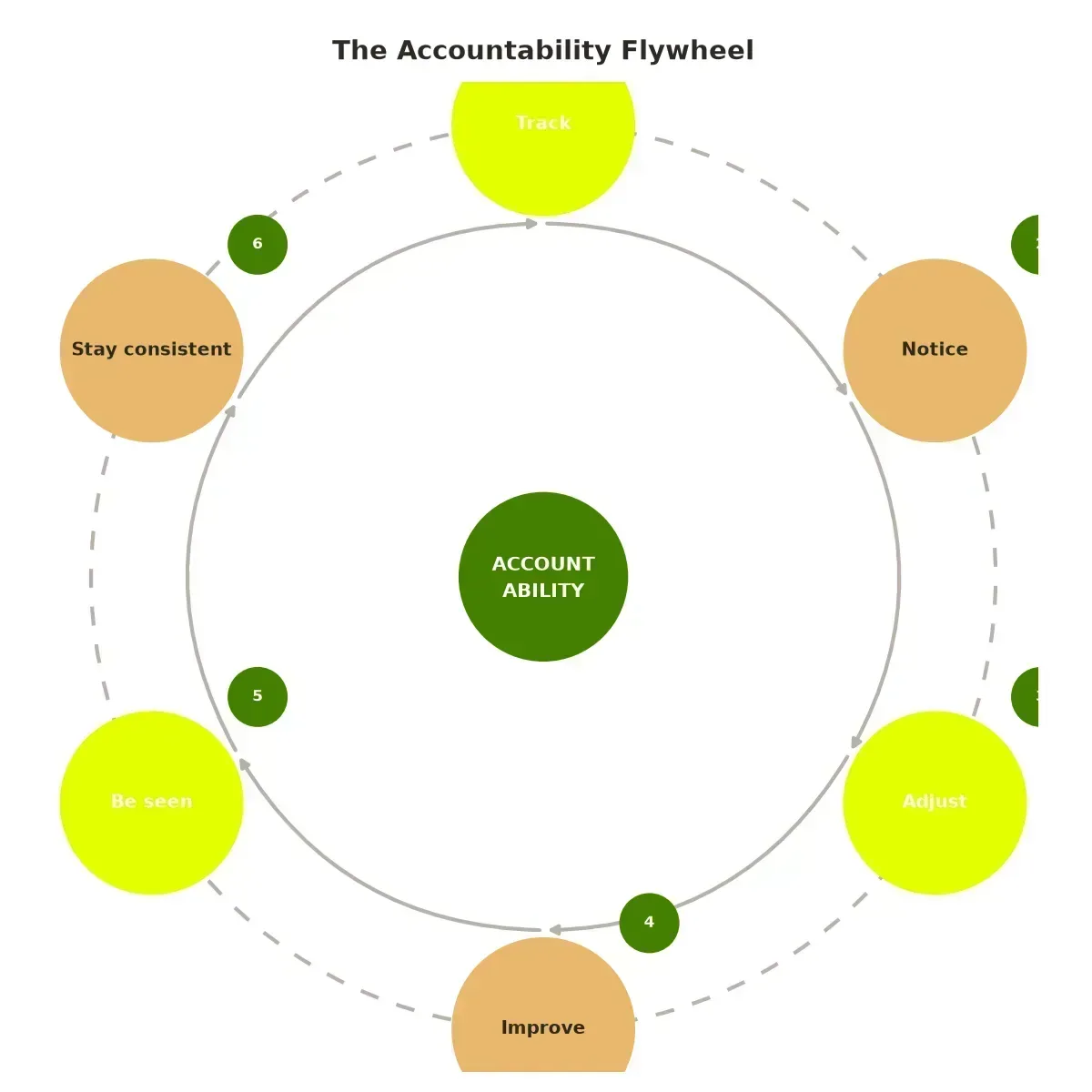
What makes these systems work is that they feed themselves. Here is the loop, in the language used throughout this article:
- You track a habit daily, so you see your data.
- You see your data, so you notice patterns.
- You notice patterns, so you make small adjustments.
- You make adjustments, so your consistency improves.
- Your consistency improves, so your accountability partner notices.
- Your partner notices, so you stay accountable.
- You stay accountable, so you keep tracking daily.
Each turn of the wheel reinforces the next. The mechanism does not depend on an endless supply of willpower; it depends on a system that turns intention into automaticity through context, and turns automaticity into durability through accountability.
How to Read the Research and Not Get Lost
A few honest caveats before you set out:
- Effect sizes are real but variable. A d of 0.65 for implementation intentions is large for psychology, but it does not guarantee success for any individual. It shifts the odds in your favor. On the concrete scale used in goal-achievement research, an effect around d = 0.6 to 0.7 typically means "several more people per hundred reach their goal than would otherwise," not "everyone succeeds."
- Habit studies are mostly short-term. The 2024 meta-analysis noted that the evidence base is thinner than it looks, with a relatively small number of high-quality studies. Treat "66 days" as a rough guide, not a law. Median is not a promise: fully half of people took longer than 66 days.
- Most habit research measures what people report, not what they do. Diary and self-report measures are standard and reasonable, but they carry bias, people are charitable to themselves on good days and discouraged on bad ones. When you see a big effect, ask whether it was measured obtrusively or unobtrusively. The habit literature is more honest than most, in that it now routinely publishes pre-registrations and large samples, but treat any single number with a grain of salt.
- What works is what you will actually do. The best intervention is the one you sustain. If you hate tracking, find a lighter form. If public commitment makes you anxious, start private and add witnesses gradually. A plan that is 80% as effective and that you do is worth more than a 100% effective plan you abandon in week two.
- The motivation quality matters. Accountability that preserves autonomy and is grounded in cared-for relationships outperforms accountability that is controlling. Build a system you would want to stay in, not one you dread.
A Note on Accountability with the Right Tools
The mechanisms above, implementation intentions, objective tracking, streaks, social witnessing, and light stakes, are exactly the kinds of features that good habit tools build in by default. The reason is not that the tools invented the psychology; it is that the psychology is strong enough that the most effective tools converged on it.
When you are choosing a tool or building a habit environment for yourself, look for these specific, evidence-backed elements:
- Objective, simple tracking with immediate feedback, not just a stray resolution.
- Streaks that protect you, that treat a missed day as survivable rather than catastrophic.
- A way to make progress visible to people who care, in an autonomy-preserving way, not just a public leaderboard.
- A lightweight social layer: a group, a partner, or a shared challenge that turns a solo goal into a witnessed one.
If you want a place to put these principles into practice, Mirror Habit was built around precisely this stack. You can track a single keystone habit objectively, watch your streak and your data, join a Guild where progress is visible to the people you choose, and run light, low-stakes challenges with friends. It is free, and it is deliberately built so you can start with the private foundations and opt into social accountability at your own pace.
mirrorhabit.pages.dev. Track privately. Compare openly. Build the system the research says works.
Sources
The claims in this article draw on the following research:
- Lally, P., van Jaarsveld, C. H. M., Potts, H. W. W., & Wardle, J. (2010). How are habits formed: Modelling habit formation in the real world. European Journal of Social Psychology, 40(6), 998-1009.
- Singh, B., Murphy, A., Maher, C., & Smith, A. E. (2024). Time to Form a Habit... Healthcare, 12(23), 2488.
- Gollwitzer, P. M., & Sheeran, P. (2006). Implementation intentions and goal achievement: A meta-analysis of effects and processes. Advances in Experimental Social Psychology, 38, 69-119.
- Sheeran, P., Listrom, O., & Gollwitzer, P. M. (2024). The when and how of planning: A meta-analysis of the scope and components of implementation intentions in 642 tests. European Review of Social Psychology.
- Forster, H. A., Zaval, L., Jachimowicz, J., Berry, D., & Weber, E. U. (2020). Friends with benefits: Social accountability increases physical activity. Social Science Research Network / PsyArXiv.
- Friends with health benefits: A field experiment. Management Science (2022), n = 774.
- Berli, C., Stadler, G., Inauen, J., & Scholz, U. (2016). Action control in dyads. Social Science & Medicine, 164, 38-47.
- Munson, S. A., et al. Effects of public commitments and accountability in a technology-supported physical activity intervention. JAMA (randomized field experiment).
- Ryan, R. M., & Deci, E. L. (2000). Self-determination theory and the facilitation of intrinsic motivation, social development, and well-being. American Psychologist, 55(1), 68-78.
- Cristia, J., Cueto, S., Malamud, O., & Aulagnon, R. (2024). Streaking to success: The effects of highlighting streaks on student effort and achievement. IDB Working Paper.
- Silverman, J., & Barasch, A. (2023). The logged-streak effect. Journal of Consumer Research (streaks and engagement).
- Volpp, K. G., et al. Financial incentive approaches for weight reduction (deposit contracts and loss aversion).
- Meeker, D., et al. (2015). Use of insurance against a small loss as an incentive strategy. Decision Analysis.
- Harkin, B., et al. (2016). Does monitoring goal progress promote goal attainment? A meta-analysis of the experimental evidence. Psychological Bulletin, 142(2), 198-229.
- Wood, W., & Neal, D. T. (2007). A new look at habits and the habit-goal interface. Psychological Review, 114(4), 843-863.
- Bateson, M., Nettle, D., & Roberts, G. (2006). Cues of being watched enhance cooperation in a real-world setting. Biology Letters, 2(3), 412-414.